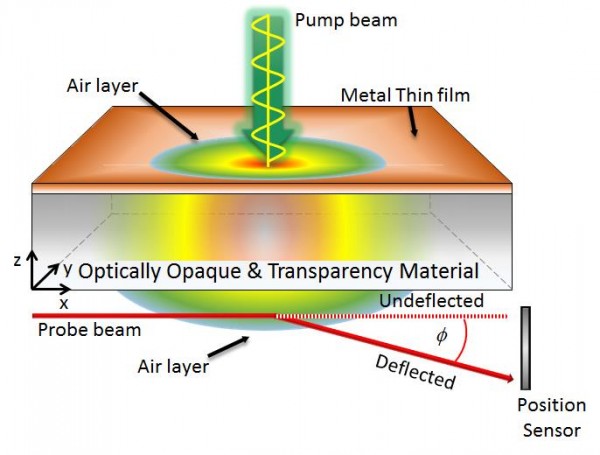
As the display industry enters a stagnant period, next-generation displays are being developed centered on four keywords: flexibility, transparency, thin film layer, and large size to get out of this stagnation period. The developed new materials were initially developed mainly for electrical characteristics, but information on thermal properties such as thermal diffusion coefficient is essential for commercialization and high efficiency of displays. In the case of materials used for displays, thermal properties such as thermal diffusion coefficient are measured mainly using non-destructive and non-contact methods with less restrictions on specimens. However, an appropriate measuring method must be applied according to the characteristics of the specimen, and there are also physical limitations according to the characteristics of the specimen to be measured.
In our laboratory, we have developed a method for measuring the thermal conductivity of opaque/transparent materials based on the photothermal effect. To measure thermal conductivity coefficient regardless of the thermal and optical properties of the measurement target material, a light-absorbing thin film absorbing energy of the heating beam by the photothermal effect was formed on the surface of the measurement target material through an electroplating process, and The thermal conductivity coefficient was measured for opaque/transparent and isotropic/anisotropic materials. Through this, unlike the existing thermal conductivity measurement methods, we developed a method that can measure thermal conductivity coefficients regardless of the thermal and optical properties of the material to be measured using light-absorbing thin films.